ملاحظة:
هذه المقالة ما زالت بحاجة إلى مزيد من المراجعة والتطوير، لتحسين الصياغة وتعميق الأفكار .
Visual Continuity in Architecture and Design
This article is a preliminary draft and requires further revision, development, and verification.
Abstract
Visual continuity in architecture and design is not produced by a single geometric or perceptual mechanism. It can emerge from the relationship between architectural composition, geometric correspondence, spatial transformation, projection, and human perception. This article proposes a framework based on three complementary levels: architectural theory, descriptive geometry, and psychology of perception.
The first level considers visual continuity as an architectural and compositional phenomenon, particularly through the distinction between literal and phenomenal transparency developed by Colin Rowe and Robert Slutzky. The second level examines the geometric dimension through descriptive geometry, including projective correspondence, homology, metric control, perspective projection, and non-linear three-dimensional morphing. The third level considers how the visual system organizes separate or complex elements according to principles such as Gestalt good continuation.
Particular attention is given to the distinction between linear projective correspondence and non-linear correspondence. Homology represents a specific form of projective correspondence, whereas morphing can establish more general correspondences in which points follow curved or otherwise non-linear trajectories. Perspective may reveal or reinforce such relationships in the visual field, but it should not be confused with the transformation itself.
The article concludes with an architectural interpretation of a stepped building composed of several spatially separated volumes. Through orthographic projections, perspective, corresponding elements, and an ideal transition surface, the example illustrates how physically discontinuous architectural elements can acquire a degree of visual continuity without becoming physically continuous.
1. Introduction: From Physical Continuity to Visual Continuity
Continuity in architecture is usually understood in physical terms: a continuous wall, a continuous surface, a connected circulation system, or a spatial sequence in which one element leads directly into another.
Visual continuity is different.
Two architectural elements may remain physically separated while appearing related, aligned, or visually connected from a particular viewpoint. Conversely, two physically connected elements may appear visually discontinuous because of a change in direction, material, scale, lighting, or perspective.
This distinction suggests that continuity should not be understood exclusively as a property of the physical object. It may also be considered a relationship established between form, correspondence, projection, and perception.
The present study therefore asks:
How can physically distinct architectural forms produce a continuous visual reading?
The question is particularly relevant to contemporary architecture, where fragmented volumes, terraces, folded surfaces, complex envelopes, and spatial morphing are frequently used to create relationships between apparently independent elements.
The proposed framework can be summarized as:
form → correspondence → transformation → projection → perception
This sequence should not be understood as a universal law, but as an interpretive framework for studying how geometric relationships can contribute to visual continuity.
First Level: Architectural Theory
Literal and phenomenal transparency
One important theoretical background is the distinction between literal transparency and phenomenal transparency developed by Colin Rowe and Robert Slutzky in their influential essay Transparency: Literal and Phenomenal. [1]

Literal transparency refers to an actual physical condition: a transparent material allows one to see through it.
Phenomenal transparency, however, concerns a visual and compositional condition in which spatial layers, planes, forms, and overlapping relationships can be perceived simultaneously or ambiguously.
Rowe and Slutzky's distinction is important because it demonstrates that architectural continuity does not necessarily depend on physical continuity. A building can produce a continuous or interconnected visual reading through the organization of planes and spatial relationships even when those relationships are physically complex or discontinuous.
This provides a theoretical foundation for considering visual continuity as something that can be constructed through relationships between forms, rather than simply through physical connection.
The distinction is particularly relevant to architectural compositions in which several planes or volumes overlap visually. What matters is not only whether elements are connected, but also how the observer organizes them into a coherent spatial reading.
Architecture as a field of relationships
From this perspective, architecture can be understood not only as a collection of objects but also as a system of relationships.
A wall relates to another wall through alignment.
A roof relates to a façade through slope and proportion.
A volume relates to another volume through position, scale, orientation, or transformation.
Visual continuity can therefore arise when these relationships are sufficiently coherent for the observer to perceive them as belonging to a common spatial or formal system.
This idea creates a bridge between architectural theory and geometry.
Second Level: Descriptive Geometry
Why descriptive geometry?
The geometric framework proposed here is descriptive geometry, rather than projective geometry alone.
Descriptive geometry provides a broader framework for representing and controlling spatial forms. It includes orthographic projection, perspective, metric relationships, spatial constructions, and projective relationships.
Projective geometry is therefore not excluded; rather, it becomes one of the geometric components through which relationships between forms can be studied.
This distinction is important because visual continuity in architecture cannot always be reduced to a projective transformation.
Some relationships are projective and linear. Others are metric. Others may involve non-linear spatial transformations.
Correspondence as the geometric foundation
The central geometric concept is correspondence.
If two forms contain identifiable elements that can be paired, a relationship can be established between them.
For example:
vertex A corresponds to vertex A′;
edge AB corresponds to edge A′B′;
face F corresponds to face F′;
a point P corresponds to a point P′.
Once such correspondences are established, one can investigate how one configuration can be related to the other.
This is the essential geometric basis of morphing.
The correspondence does not necessarily imply that the two forms are identical, similar, homologous, or projectively equivalent. It simply establishes which elements are considered related.
This distinction becomes particularly important when dealing with complex architectural forms.
Linear and Non-Linear Correspondence
4.1 Homological correspondence
In projective geometry, homology is a particular type of projective transformation characterized by a center and an axis.
It establishes a linear/projective correspondence between two configurations.
Such a correspondence can be extremely useful in architecture because it provides a rigorous way of relating corresponding elements while preserving projective relationships.
However, homology should not be treated as the general explanation for every form of visual continuity.
It is one particular type of correspondence.
Non-linear correspondence
Morphing introduces a broader possibility.
A point of one form may correspond to a point of another form while following a non-linear trajectory during the transformation.
The trajectory does not necessarily have to be a straight line.
Likewise, the intermediate configurations do not necessarily have to belong to a projective family.
This means that the geometric correspondence used in morphing can be more general than homology.
In a three-dimensional transformation, corresponding vertices may move along curved spatial paths, while corresponding edges and surfaces change continuously according to the chosen transformation rules.
This distinction is fundamental:
Homology is a particular projective correspondence; morphing can employ a more general, including non-linear, correspondence.
Research on 3D morphing confirms the importance of maintaining correspondence between geometric elements while transforming one spatial configuration into another. Feature-based morphing, for example, explicitly establishes relationships between corresponding regions and polygons while preserving geometric connectivity. [2]
Thus, correspondence is not merely a visual interpretation; it can also constitute a precise geometric framework for transformation.
Morphing as a Geometric Transformation
Morphing may be understood as a continuous transformation between two configurations.
Suppose we have an initial form F₀ and a final form F₁.
A morphing process establishes a sequence:
F₀ → F₁
through intermediate configurations:
F₀ → F₁/₂ → F₁
The essential question is not simply how to interpolate coordinates numerically, but how the geometric elements of one configuration correspond to those of the other.
For architectural applications, this distinction is important because the designer may wish to control:
which vertices correspond;
which edges correspond;
how surfaces change;
which trajectories are straight or curved;
where curvature increases;
where volumes expand or contract;
whether self-intersections are avoided;
and how the transformation is perceived from selected viewpoints.
The resulting transformation can therefore be considered a designed geometric process, rather than merely a computational interpolation.
6. Architectural Examples of Morphing and Continuity
The idea of morphing is not limited to contemporary digital software. Architectural historians have identified early examples of shape transformation in projects such as Antoni Gaudí's Sagrada Família and Le Corbusier's Firminy Chapel. Park's study of early shape morphing examines these architectural examples in relation to the broader concept of transforming one geometric configuration into another. [3]
Contemporary computational research has subsequently developed increasingly sophisticated methods for three-dimensional morphing, including feature-based correspondence between polyhedral objects. [2]
These studies demonstrate that morphing can be considered not simply as an image-processing operation but as a geometric strategy for generating and controlling form.
In architecture, however, the important issue is not merely that a form can morph.
The important issue is how the correspondence is designed and how the resulting transformation is perceived.
Habitat 67: Continuity Through Repetition and Displacement
A useful architectural example is Habitat 67 by Moshe Safdie.
The project consists of prefabricated residential modules arranged in a stepped configuration. Safdie's official description emphasizes the modular organization and the stepped-back placement of the units, which creates individual terraces and a complex three-dimensional composition. [4]
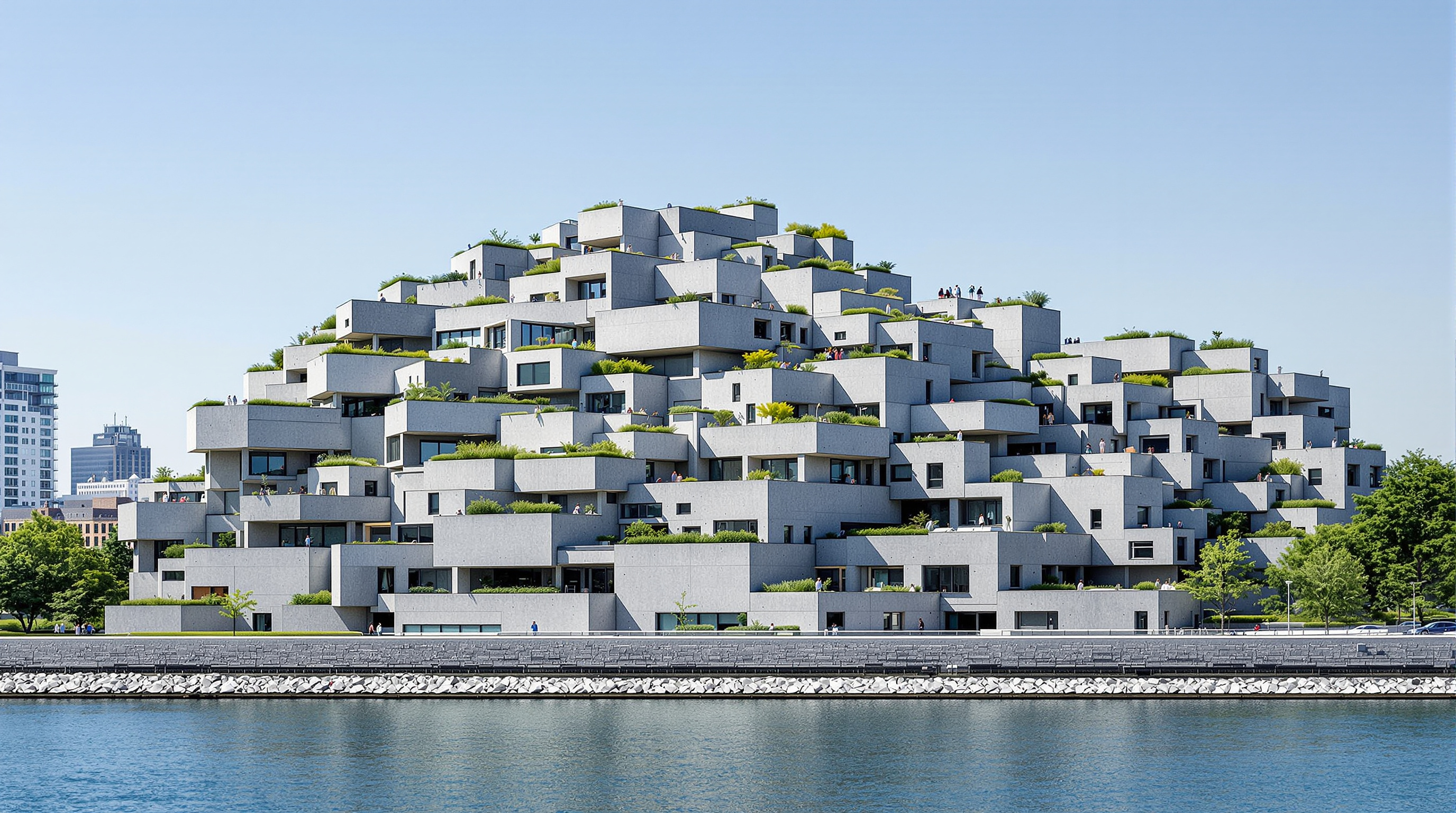 |
| Repetition, displacement and visual coherence |
The project does not constitute an example of morphing in the strict geometric sense proposed here. Rather, it provides an architectural analogy.
Repeated modules undergo controlled displacement and stacking. The resulting composition is neither a simple isolated collection of objects nor a single continuous mass.
The visual continuity emerges from the relationships between:
repetition,
alignment,
displacement,
scale,
terrace formation,
and the overall stepped geometry.
The example therefore illustrates an important principle:
A composition can maintain visual coherence even when its physical elements remain individually distinguishable.
This is different from continuous surface morphing, but it belongs to the same broader problem of constructing relationships between separate forms.
Perspective: From Spatial Separation to Visual Continuity
Perspective introduces another important dimension.
A three-dimensional architectural configuration is projected onto a two-dimensional image according to a viewpoint.
The projection can change the apparent relationships between spatial elements.
Two elements separated in space may appear aligned in projection.
Two surfaces at different depths may appear to meet visually.
A gap may become less legible.
Several edges may appear to belong to one continuous direction.
However, perspective itself should not be confused with morphing.
Perspective is a projection. Morphing is a transformation.
Perspective transforms the representation of a spatial configuration according to a viewpoint.
Morphing transforms one spatial configuration into another.
The two can nevertheless interact.
A carefully designed morphing transformation may be studied from a viewpoint in which its corresponding elements become particularly legible. Conversely, a perspective projection may reveal relationships that are difficult to perceive in orthographic views.
Case Study: A Stepped Architectural Volume
Consider a building composed of three vertically displaced volumes.
The volumes are physically separated by terraces or horizontal setbacks.
In an orthographic representation, the separation is clearly visible.
The plan, elevation, and section reveal the independent spatial positions of the three volumes.
However, from a carefully selected perspective, certain corresponding points or edges may align with the projection center.
The resulting image can reduce the perceptual importance of the physical separation.
The three volumes may consequently be read as parts of a larger visual configuration.
This does not mean that the terraces disappear physically.
Rather:
Their separation becomes less visually dominant in the selected projection.
This distinction is essential.
The physical configuration remains discontinuous, while the projected image can establish a stronger visual relationship between its components.
 |
| geometric case study |
From Correspondence to a Transition Surface
Suppose corresponding points are identified between the three volumes.
We can then connect selected corresponding points and study the family of trajectories produced between them.
If the correspondence is continuous and the trajectories are organized appropriately, these connections may generate an intermediate geometric structure.
In certain configurations, a continuous family of connecting lines can define a ruled surface. In other cases, curved trajectories can produce a more general transition surface.
The resulting surface should be understood as an ideal geometric construction.
It does not necessarily represent a surface that must be physically constructed.
Its purpose may instead be to reveal the geometric continuity hidden between apparently separate architectural configurations.
This provides an important methodological distinction:
physical surface ≠ geometric transition surface ≠ visual continuity
The three concepts can interact, but they are not identical.
Morphing Through a Visual Sequence
The stepped building can now be interpreted as a morphing sequence.
Instead of treating the three volumes as isolated objects, we can consider them as successive states of a geometric transformation.
For example:
Volume A → intermediate configuration → Volume B → intermediate configuration → Volume C
The intermediate states may be generated through corresponding points, edges, and surfaces.
The transformation may be linear in some regions and non-linear in others.
The trajectories may be straight, curved, or controlled by additional geometric conditions.
This is where the concept becomes broader than projective correspondence.
A projective transformation can explain certain relationships.
A morphing transformation can explain others.
Descriptive geometry provides the larger environment in which both can be studied.
Third Level: Psychology of Perception
Geometry alone does not explain why a visual relationship is perceived as continuous.
The observer also plays an essential role.
Gestalt psychology provides an important conceptual framework for understanding this process.
One of its central principles is the law of good continuation: visual elements tend to be organized into continuous and coherent paths rather than being perceived as unrelated fragments.
Psychophysical research has subsequently investigated this principle experimentally. Field, Hayes, and Hess studied contour integration and described mechanisms through which the visual system organizes local contour elements into larger coherent structures. [5]
The implication for architecture is significant.
If two physically separate architectural elements establish compatible directions, alignments, curvatures, or rhythms, the observer may perceive them as belonging to a common visual structure.
The geometry therefore provides the conditions for continuity, while perception determines how those conditions are organized visually.
Geometry and Perception Are Not the Same Thing
It is important not to confuse geometric continuity with perceptual continuity.
A mathematically continuous curve may appear visually interrupted.
Conversely, physically separated elements may appear visually connected.
Therefore:
geometric continuity is a property of a geometric configuration;
visual continuity is a property of the relationship between the configuration and the observer.
This distinction explains why the same building can produce different visual readings from different viewpoints.
A change of viewpoint can alter projection.
A change of projection can alter apparent alignment.
A change in alignment can alter perceptual grouping.
The continuity is therefore partly dependent on the observer's position.
Heydar Aliyev Center: Continuous Architectural Reading
The Heydar Aliyev Center in Baku, designed by Zaha Hadid Architects, provides a useful contemporary architectural example.
The architects describe the project through the idea of a continuous relationship between the surrounding plaza and the building interior, and describe the ambition of creating a surface that appears highly continuous and homogeneous. [6]
The project is not evidence that the architects used the specific morphing method proposed in this article.
Rather, it is an example of an architectural strategy in which continuous geometric relationships are deliberately used to reduce the perceptual distinction between ground, wall, roof, and interior.
The building therefore illustrates the architectural relevance of the broader principle:
continuity can be designed not only as physical connection but also as a continuous visual and spatial reading.
The geometric complexity of the building is consequently inseparable from the way it is perceived.
 |
Continuous architectural surface |
Mercedes-Benz Museum: Intersecting Spatial Trajectories
Another interesting case is the Mercedes-Benz Museum in Stuttgart by UNStudio.
The building is organized around a trefoil geometry and two interlocking circulation trajectories. UNStudio describes these trajectories as continuously crossing and connecting the different spatial areas of the museum. [7]
Here the continuity is not produced simply by a continuous external surface.
It is also produced by movement through space.
The visitor follows trajectories that connect different levels and exhibition spaces.
This example broadens the concept of visual continuity toward spatial continuity.
Architecture can therefore establish continuity through:
surfaces;
volumes;
alignments;
circulation;
perspective;
and transformation.
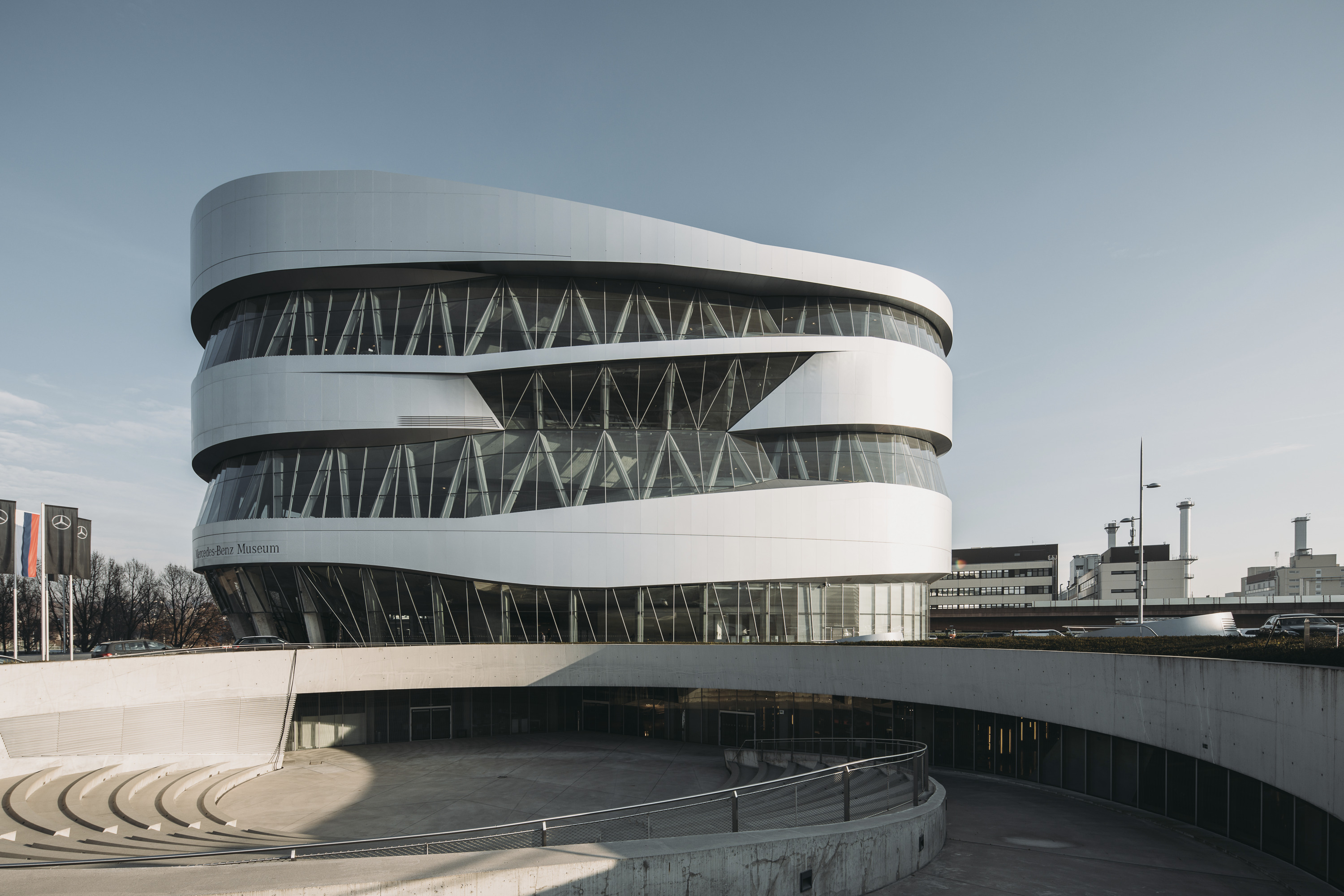
Spatial trajectories and continuity through movement
Visual Continuity and the Observer's Point of View
The viewpoint becomes especially important when physically separated elements are intended to appear visually related.
Consider again the stepped building.
From one viewpoint:
Volume A — gap — Volume B — gap — Volume C
may be clearly perceived as three independent objects.
From another viewpoint, however:
Volume A → Volume B → Volume C
may be perceived as a more coherent visual sequence.
The architectural object has not changed.
The projection has changed.
This demonstrates that visual continuity may be view-dependent.
Consequently, an architectural design intended to produce a particular visual continuity should not be evaluated exclusively through plans or elevations. Perspective views and spatial observation become necessary.
Morphing Beyond Perspective
At this point, it is important to distinguish two processes that can easily be confused.
Perspective
Perspective establishes a relationship between a three-dimensional configuration and a two-dimensional image through a projection center.
Morphing
Morphing establishes a transformation between two or more configurations through correspondence.
A morphing process may be observed through perspective, but perspective does not create the morphing.
Likewise, a perspective relationship may reveal a correspondence without defining a transformation between the forms.
This distinction prevents the geometric framework from becoming conceptually contradictory.
Linear Correspondence as a Special Case
If corresponding points are connected by straight trajectories and the transformation satisfies projective conditions, the resulting correspondence may be interpreted within a projective framework.
Homology is one important special case.
But this should be understood as a subset of a larger field.
A possible hierarchy is therefore:
Descriptive geometry
→ projective geometry
→ projective correspondences
→ homology
while, alongside these:
Descriptive geometry
→ spatial transformation
→ non-linear correspondence
→ 3D morphing
The two branches can interact, but neither should be reduced to the other.
This is one of the central arguments of the present article.
Toward a Synthetic Approach to Morphing
The proposed approach is intentionally geometric and synthetic.
Instead of beginning with numerical interpolation, it begins with geometric relations.
The designer first identifies:
the initial configuration;
the final configuration;
the corresponding elements;
the geometric constraints;
the desired trajectories;
the intermediate configurations;
the final visual reading.
This approach places the designer in control of the transformation.
The computer can then assist in constructing, visualizing, and refining the transformation, but the geometric logic remains explicit.
This is particularly relevant to architectural design because a morphing process should not become a black-box operation that produces an unpredictable shape.
The transformation itself can become part of the design.
Continuity as a Design Strategy
From an architectural point of view, visual continuity can be deliberately constructed through several mechanisms:
Alignment
Corresponding edges, axes, openings, or structural elements can establish visual relationships.
Repetition
Repeated elements can establish a continuous rhythm across physically separated parts.
Gradual transformation
A sequence of related configurations can create a sense of continuous change.
Curved trajectories
Non-linear paths can connect corresponding elements and produce smooth spatial transitions.
Perspective alignment
A selected viewpoint can strengthen the apparent relationship between separate elements.
Surface continuity
A continuous surface can physically and visually connect different spatial regions.
Perceptual grouping
Compatible directions and contours can encourage the observer to group separate elements into a single visual structure.
These mechanisms are not equivalent.
They belong to different levels of the problem, but they can reinforce one another.
Three Levels of Visual Continuity
The discussion can therefore be summarized through three complementary levels.
Level 1 — Architectural Theory
The first level concerns the architectural and compositional meaning of continuity.
It asks how buildings create relationships between planes, volumes, layers, transparency, movement, and spatial sequences.
Rowe and Slutzky's distinction between literal and phenomenal transparency is particularly relevant here. [1]
Level 2 — Descriptive Geometry
The second level concerns the geometric construction of relationships.
It includes:
orthographic projection;
perspective;
metric control;
projective correspondence;
homology;
spatial correspondence;
and non-linear 3D morphing.
This level provides the geometric tools for describing and constructing continuity.
Level 3 — Psychology of Perception
The third level concerns how the observer organizes what is seen.
Gestalt principles, including good continuation, help explain why aligned or smoothly related elements may be perceived as parts of a coherent visual structure. [5]
These three levels should not be collapsed into one another.
Architecture provides the design intention.
Geometry provides the construction and representation.
Perception provides the visual interpretation.
An Integrated Model
The three levels can be represented schematically as:
ARCHITECTURE
↓
composition and spatial intention
DESCRIPTIVE GEOMETRY
↓
correspondence → transformation → projection
PERCEPTION
↓
visual grouping → continuity
This produces a more complete interpretation of visual continuity than any single discipline can provide.
The architect or designer begins with a spatial intention.
Descriptive geometry allows the relationships to be constructed and controlled.
Projection determines how the relationships are presented from a particular viewpoint.
The observer then organizes the resulting image according to perceptual mechanisms.
The Stepped Building Revisited
The stepped-building example can now be interpreted through all three levels.
Architectural level
The building consists of separate volumes arranged in a deliberate stepped composition.
Geometric level
Corresponding points and edges are identified between the volumes. These correspondences can be linear/projective in some cases or non-linear in a morphing transformation.
Projection level
A selected viewpoint may align certain corresponding elements and reduce the visual dominance of the gaps.
Perceptual level
The observer may group the aligned elements into a larger visual sequence.
The result is not physical continuity.
It is visual continuity produced through the interaction of spatial configuration, geometric correspondence, projection, and perception.
Toward a General Definition
On the basis of the preceding discussion, visual continuity in architecture and design can provisionally be defined as:
A perceived relationship of coherence between spatial or formal elements that may be physically connected or separated, produced through geometric correspondence, transformation, alignment, projection, and perceptual organization.
This definition deliberately avoids restricting continuity to a single geometric mechanism.
It allows for:
physical continuity;
projective continuity;
geometric correspondence;
non-linear transformation;
perspective alignment;
and perceptual continuity.
Conclusion
Visual continuity in architecture and design cannot be adequately explained by geometry alone, nor by perception alone.
It emerges from the interaction of several systems.
Architectural theory explains how spatial and formal relationships acquire compositional meaning.
Descriptive geometry provides the framework for constructing and representing those relationships, incorporating both projective and metric aspects.
Projective geometry contributes precise forms of correspondence such as homology, while morphing extends the concept toward more general and potentially non-linear transformations.
Perspective determines how a spatial configuration is projected from a particular viewpoint, but it should not be confused with the transformation itself.
Psychology of perception explains why the observer may organize separate elements as belonging to a coherent visual structure.
The resulting conceptual sequence can therefore be expressed as:
form → correspondence → transformation → projection → perception
Within this framework, visual continuity is not necessarily the result of physical continuity.
A building may remain fragmented in space while becoming continuous in perception.
This opens a broader field for architectural design: continuity can be designed as a geometric, visual, spatial, and perceptual relationship.
The proposed approach is therefore not intended to replace established architectural, geometric, or perceptual theories. Rather, it attempts to connect them through a common problem: how relationships between forms can generate continuity without requiring physical identity or physical connection.
The present text remains a working draft. The theoretical framework, geometric terminology, architectural case studies, and references require further development, comparison with additional literature, and verification before the article can be considered a finalized research paper.
References
[1] Rowe, C., & Slutzky, R. (1971). Transparency: Literal and Phenomenal, Part II. Perspecta, 13/14, 287–301.
[2] Li, X., et al. (2012). Feature-based 3D morphing based on geometrically constrained spherical parameterization. Computer-Aided Geometric Design, 29(1), 2–17.
[3] Park, H. (2005). Early Shape Morphing: The Metamorphosis of Polygons in Antoni Gaudí's Sagrada Família Cathedral and Le Corbusier's Firminy Chapel.
[4] Safdie Architects. Habitat 67. Official project documentation.
[5] Field, D. J., Hayes, A., & Hess, R. F. (1993). Contour integration by the human visual system: Evidence for a local “association field”. Vision Research, 33(2), 173–193.
[6] Zaha Hadid Architects. Heydar Aliyev Center. Official project documentation.
[7] UNStudio. Mercedes-Benz Museum. Official project documentation.
[8] Rowe, C. (1976). The Mathematics of the Ideal Villa and Other Essays. MIT Press.
[9] Arnheim, R. (1977). The Dynamics of Architectural Form. University of California Press.
[10] Jiang, Y., et al. (2022). Shape-morphing mechanical metamaterials. Computer-Aided Design, 143, 103146.

